53 seconds · Captions included · Illustrations, camera movement and synthetic character voices
Read the trailer transcript
Narrator: Small wildlife. Massive opinions.
Bramble: I've appointed myself leader. Democracy was taking too long.
Moss: You were the only candidate.
Bramble: And yet, a landslide.
Narrator: Six species. More opinions than chairs.
Hope: You've held three meetings about a puddle?
Bramble: Four. The first established it was a puddle.
Hope: Good. Wouldn't want to rush the science.
Narrator: Meet the residents. Management currently disputed.
Narrator: Hope knows the way. Faith has a question.
Faith: If you're in charge, why doesn't anyone listen?
Narrator: Extinctables. We ain't dead yet. Created by Hope. Developed by Dad. Adventures with Hope and Faith.
The residents
A very qualified group of opinions.
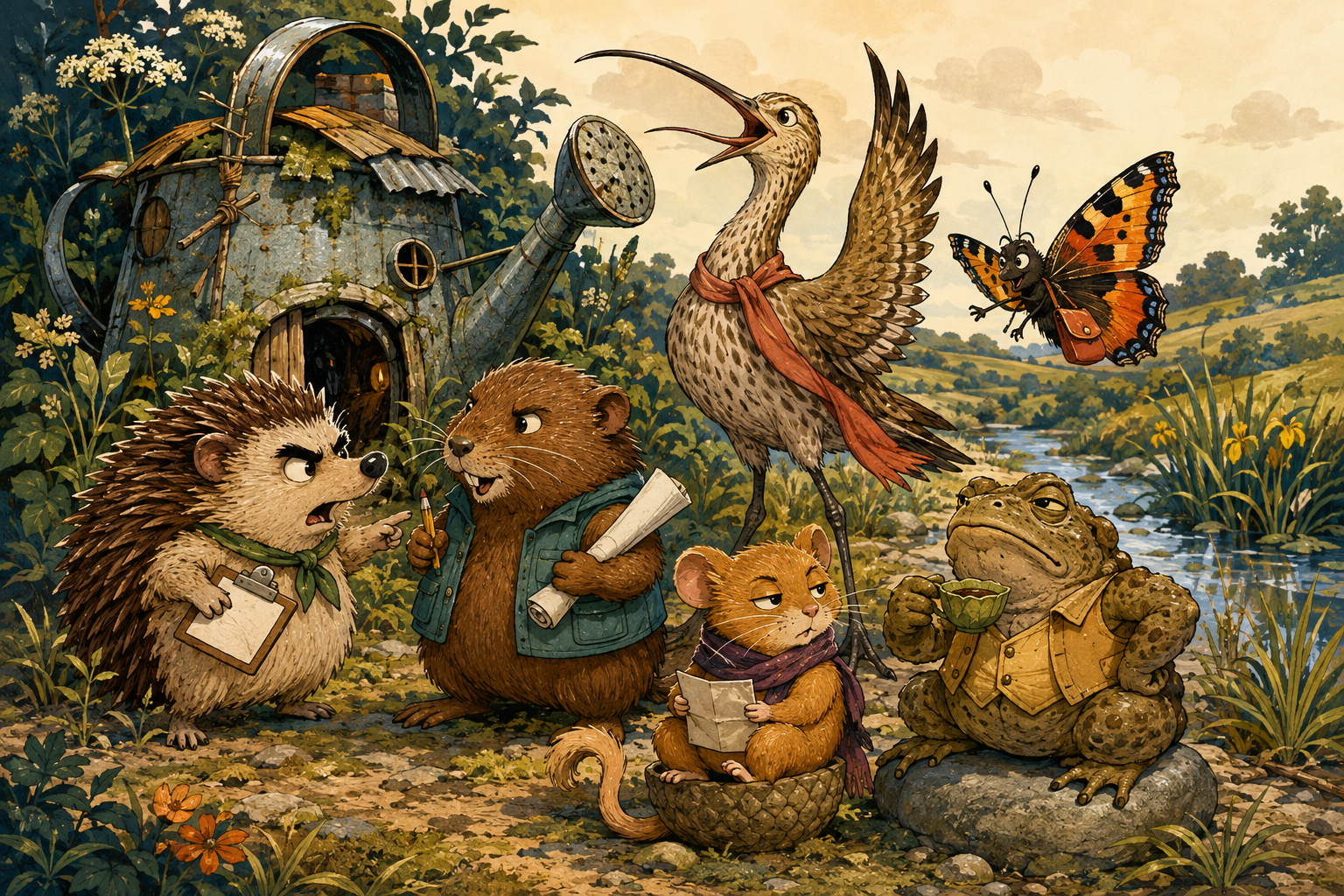
Big personalities. Questionable decisions. Surprisingly good friends. Open a profile to meet the animal behind the attitude.
European hedgehog
Bramble
Head of being in charge
“Democracy was taking too long.”
Meet Bramble
Bramble has appointed himself manager of the Patch. Nobody remembers applying for a manager. He has a clipboard, though, which makes the situation surprisingly difficult to challenge.
Actually quite good atBrave, persistent and excellent at noticing when somebody has been left out. When things go properly wrong, he turns up.
ComplicationsConfuses being useful with being in charge. A small problem becomes a strategic initiative before breakfast.
Usually heard saying“I’m supervising. Faith says that’s carrying a bag with opinions.”
Friends at the PatchFaith is his best friend and favourite fellow explorer. He insists he is in charge; she lets him announce where she has already decided they are going. Hope can defeat an entire speech with one raised eyebrow.
The real animalA hedgehog needs connected places to forage and shelter. Fences and fragmented habitat can make a small journey a big problem. Rural and urban population trends differ. Wildlife source ↗
European water vole
Banks
Engineer. Apparently everyone’s engineer.
“That is a label. The problem is still underneath it.”
Meet Banks
Banks fixes things while the others discuss whose department things belong to. She is practical, inventive and beginning to suspect that competence was a serious tactical error.
Actually quite good atSpots how things connect, makes useful plans and keeps going when the glamorous solution falls apart.
ComplicationsWould rather redo everybody’s work than explain how to help. Her perfectionism can become another form of control.
Usually heard saying“Excellent suggestion. Which part have you measured?”
The real animalWater voles live beside water and use bankside vegetation. Their burrowing and feeding help shape habitat. They have suffered severe declines, with some encouraging local recoveries. Wildlife source ↗
Hazel dormouse
Moss
Resident expert in technically everything
“I’m not avoiding the task. I’m questioning its premise.”
Meet Moss
Moss can turn ‘I don’t fancy doing that’ into a surprisingly persuasive lecture. Usually the quietest person in the meeting, and somehow the one everyone ends up arguing with.
Actually quite good atSees the assumption everybody else has missed. A patient observer with a secret streak of generosity.
ComplicationsUses cleverness to stay safely on the sidelines. Being technically correct is easier than trying something that might fail.
Usually heard saying“That’s an interesting theory. It appears to be allergic to evidence.”
The real animalHazel dormice use woodland, scrub and connected hedgerows. Monitoring in established British woodlands recorded a major decline between 2000 and 2022. Wildlife source ↗
Eurasian curlew
Nell
Communications. All of them. At volume.
“It wasn’t a scene. It was a public-facing moment.”
Meet Nell
Nell treats every announcement as an opening night. She has presence, projection and absolutely no instinct for whether an audience has somewhere else to be.
Actually quite good atCan rally a discouraged crowd, remember everybody’s name and make a lonely newcomer feel included.
ComplicationsTurns ordinary setbacks into productions. Sometimes performs confidence instead of saying she is worried.
Usually heard saying“I have prepared a short statement. Emotionally short.”
The real animalCurlews are long-legged wading birds with long downward-curving bills. Britain’s breeding population has declined sharply. Suitable wet feeding areas and breeding habitat matter. Wildlife source ↗
Common toad
Boggs
Standards, complaints and a very important cup
“‘Common’ is a distribution category. Kindly adjust your tone.”
Meet Boggs
Boggs has standards. Nobody asked for them, but they have arrived in writing. He regards his pebble as an institution and his leaf cup as an heirloom of considerable cultural significance.
Actually quite good atRemembers the Patch’s history, keeps promises and quietly makes room for someone with nowhere to sit.
ComplicationsMistakes familiar for fair. Defends a rule most fiercely when it happens to benefit him.
Usually heard saying“I don’t do mud. Yes, I’m a toad. I’m trying to rise above it.”
Friends at the PatchFaith is his best friend and favourite adventuring companion. He calls their outings inspections; she calls them fun. He complains about coming, then gets ready first. Bramble completes their unlikely little trio.
The real animalCommon toads spend much of their time on land and return to water to breed. Long-term UK monitoring has documented serious declines. Roads can interrupt their journeys to breeding ponds. Wildlife source ↗
Small tortoiseshell butterfly
Flick
Breaking news. Occasionally breaking facts.
“I said it was breaking news. I didn’t say it was finished.”
Meet Flick
Flick knows everything three minutes before everyone else. Unfortunately, the explanation tends to arrive four minutes later. Fast, charming and dangerously enthusiastic about a headline.
Actually quite good atSees connections between people, finds information and will go back to correct a mistake even when it is embarrassing.
ComplicationsConfuses being first with being right. Gets excited by a possibility before checking whether it is an actual possibility.
Usually heard saying“I have several sources. They’ve all heard it from me.”
The real animalSmall tortoiseshell caterpillars feed on stinging nettles; adults drink nectar. UK monitoring shows a substantial long-term abundance decline, despite variation between years. Wildlife source ↗
Two familiar faces
Hope knows the way. Faith has a question.
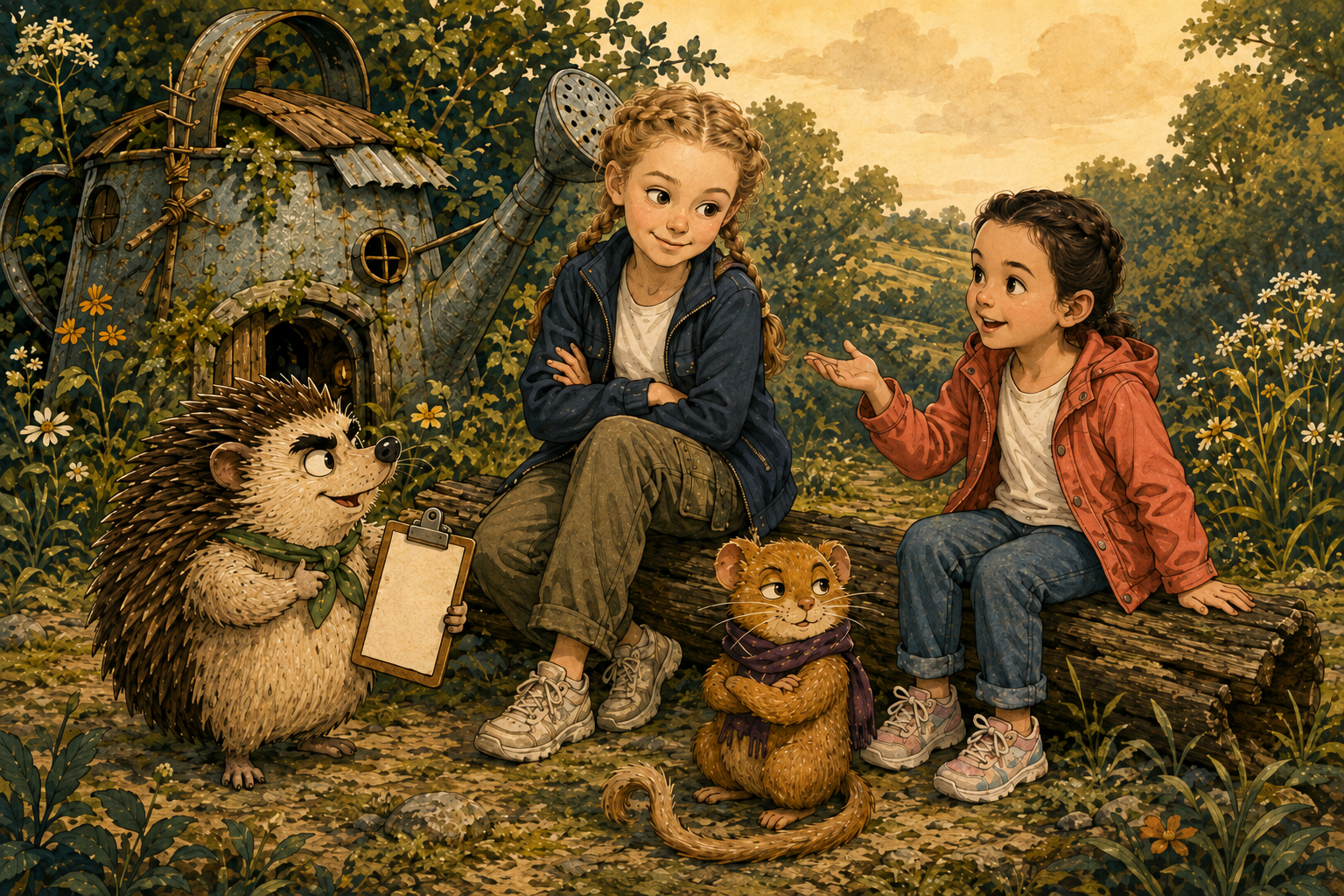
At the edge of Bracken Beck, a hedge hides a very opinionated little world. Hope found her way in. Her younger sister Faith was never going to stay outside.
Hope
Curious, quick-witted and extremely difficult to impress with a clipboard. She can spot a flaw in Bramble’s plan. Occasionally it is her own plan.
“That’s a very long explanation for ‘we forgot’.”
Faith
An explorer with her own ideas, and best friends with Bramble and Boggs. She can get a bossy hedgehog to carry the bags and a very dignified toad to go on an adventure. Boggs insists he was going that way anyway.
“If you’re in charge, why doesn’t anyone listen?”
Created by Hope. Developed with Dad. Adventures featuring Hope and Faith.
The adventures
Two stories. Plenty of opinions.
Episode 2 · Faith & Boggs
Boggs Has a Day Off
A quiet picnic. One runaway tin. Absolutely no fun intended.
Created by Hope. Developed by Dad. Adventures with Hope and Faith.
Illustrated film with camera movement, character dialogue, music and sound effects. Synthetic character voices. Story and illustration development with AI assistance.
Episode 1 · An illustrated adventure
The Committee for Doing Absolutely Nothing
Read along, or press play and let the cast tell the story.
Listen to the storyFull cast · 7 min · Synthetic voices
The audio could not load. Try the direct audio link above.
EXTINCTABLES · A WORLD FROM HOPE’S IMAGINATION
An Extinctables adventure
The Committee for Doing Absolutely Nothing
One misread sign. Six experts. A deeply unnecessary clipboard.
Welcome to the Patch, where everyone thinks they’re the sensible one.
Created by Hope. Developed with Dad. Adventures featuring Hope and Faith.
1
EXTINCTABLES · A WORLD FROM HOPE’S IMAGINATION
The Committee for Doing Absolutely Nothing
A landslide victory
By the time Hope and Faith reached the Patch, Bramble had formed a committee. This was rarely a sign that things were going well.
“I’ve appointed myself leader,” he announced. “Democracy was taking too long.”
Moss looked up from his paper. “You were the only candidate.”
“And yet,” said Bramble, “a landslide.”
Banks returned to the little bridge she was drawing. Across the stream, a new notice fluttered on the park gate. Flick had returned from reading some of it.
2
EXTINCTABLES · A WORLD FROM HOPE’S IMAGINATION
The Committee for Doing Absolutely Nothing
Breaking news. Mostly.
“Official inspection. Saturday. This place is about to be judged,” said Flick.
“By whom?” asked Banks.
“Officials. It’s in the name.”
“Finally,” said Boggs, straightening his waistcoat. He had been waiting for an opportunity to explain what was wrong with everyone’s arrangement of leaves.
Nell offered to prepare a welcome address. Banks asked whether it could be a short one.
“Let’s not censor the arts before lunch,” said Nell.
Bramble tapped his clipboard. It contained one word: IMPORTANT. Underlined twice. The second line appeared to be doing most of the work.
3
EXTINCTABLES · A WORLD FROM HOPE’S IMAGINATION
The Committee for Doing Absolutely Nothing
An excellent place for a meeting
The committee moved its table into the gap beneath the hedge. It was shady there. It was also the route everybody used to reach the next garden.
Faith peered into the gap. “If everyone is in charge, who’s actually helping?”
“A temporary inconvenience in pursuit of long-term efficiency,” said Bramble.
Banks pointed at the table. “You’ve blocked the shortcut to hold a meeting about improving the shortcut.”
“There’s an elegant circularity to it,” said Moss.
“There’s a table in it,” said Banks.
4
EXTINCTABLES · A WORLD FROM HOPE’S IMAGINATION
The Committee for Doing Absolutely Nothing
Standards have arrived
Boggs began labelling things. A wonky twig became UNSATISFACTORY. An entirely ordinary stone became HERITAGE. The stone was his.
“These nettles will need a review,” he said.
Flick fluttered over. “Those are the nursery buffet.”
“They look untidy.”
“So does lunch when someone’s eating it.”
Nell rehearsed her opening statement. Somewhere during the third introduction, Moss announced that a meaningful assessment of tidiness would require a shared philosophical framework.
“Is that dormouse for ‘I’m not doing it’?” asked Hope.
“It loses some nuance in translation,” said Moss.
5
EXTINCTABLES · A WORLD FROM HOPE’S IMAGINATION
The Committee for Doing Absolutely Nothing
A significant puddle
Hope sat on the log beside the watering can. In front of her stood a puddle surrounded by four labels.
She looked at the labels. She looked at Bramble.
“You’ve held three meetings about a puddle?”
“Four,” said Bramble. “The first established it was a puddle.”
“Good,” said Hope. “Wouldn’t want to rush the science.”
Faith leaned over to inspect this exceptionally well-documented puddle. It continued being a puddle without submitting any paperwork.
6
EXTINCTABLES · A WORLD FROM HOPE’S IMAGINATION
The Committee for Doing Absolutely Nothing
Read the bottom of the sign
Hope went to look at the notice. Flick came too, for what he described as “additional confirmation”. A curled corner had hidden the bottom lines.
Hope lifted it. “It says: ‘Wildlife survey, Saturday. Please leave the wild margins undisturbed. Keep the footpath clear.’”
“Yes,” said Flick. “That is a much longer version of the information.”
“You didn’t read all of it,” said Banks, arriving behind them.
“I read the urgent part.”
“An exciting new approach to accuracy,” said Moss.
7
EXTINCTABLES · A WORLD FROM HOPE’S IMAGINATION
The Committee for Doing Absolutely Nothing
The untidiness is allowed
For a moment, everyone was quiet. Even Nell, who regarded silence as a gap in the programme.
“So the untidiness has been independently endorsed?” asked Boggs.
Hope looked at the nettles and the leaves beneath the hedge.
“It’s somewhere to live, Boggs. It doesn’t have to look like a reception desk.”
Beyond the gate, the stream slipped past the meadow. The Patch had been doing rather well at being a home before anyone brought out the labels.
8
EXTINCTABLES · A WORLD FROM HOPE’S IMAGINATION
The Committee for Doing Absolutely Nothing
A less impressive afternoon
Bramble looked at the nettles, the fallen leaves and the little route now occupied by his committee. His face lost its managerial expression.
“I thought if we looked organised, they’d know we mattered.”
Hope sat beside him.
“You do matter. The clipboard’s having a less impressive afternoon.”
Across the grass, Banks nudged the table. It did not move. She had built it herself and had, unfortunately, done an excellent job.
“All right,” she said. “I need help.”
“A historic announcement,” said Moss.
“You can commemorate it from that end.”
9
EXTINCTABLES · A WORLD FROM HOPE’S IMAGINATION
The Committee for Doing Absolutely Nothing
An outbreak of actual activity
With everyone helping, the table came out of the gap.
Nell counted them in. Banks directed. Bramble stopped directing long enough to lift. Moss put down the paper. Boggs surrendered his preferred corner.
For once, the important thing happened before anybody had written a heading for it.
The shortcut was open again. The nettles stayed where the caterpillars needed them. The leaves stayed where small creatures could shelter.
Bramble looked at his clipboard. There was, he had to admit, rather less need for it just now.
10
EXTINCTABLES · A WORLD FROM HOPE’S IMAGINATION
The Committee for Doing Absolutely Nothing
A small issue with the map
Hope had an idea for a little map showing the meadow, pond, stream and hedge. Faith found a flat place to draw it.
Hope drew a beautiful line straight through Boggs’s seat.
“A bold proposal,” said Boggs. “Have we considered going round the toad?”
“Fair point,” said Hope. “My planning department has been overconfident.”
They revised it together. Banks marked the routes; Nell named the meadow; Flick added the nettles and went to correct the inspection story.
Twice, because the first correction was also rather dramatic.
11
EXTINCTABLES · A WORLD FROM HOPE’S IMAGINATION
The Committee for Doing Absolutely Nothing
Emotionally, very short
At the hedge, Bramble placed his IMPORTANT label above the open gap. For once, everybody agreed with his paperwork.
“Would anyone like to hear my statement now?” asked Nell.
“How long is it?” said Boggs.
“Emotionally, very short.”
Hope was still laughing when Bramble announced that the committee had achieved its objective and would therefore be dissolved.
“Excellent,” said Moss.
“And replaced with a task force.”
“Naturally.”
12
EXTINCTABLES · A WORLD FROM HOPE’S IMAGINATION
The Committee for Doing Absolutely Nothing
Does exploring need a meeting?
Boggs raised his leaf cup. “I assume my title carries over?”
“Only if it fits through the gap,” said Hope.
Faith was already looking beyond the hedge. There were paths to try, stones to inspect and all sorts of things nobody had had the chance to label yet.
“I’m going exploring,” she announced. “Does that need a meeting?”
Moss folded his paper.
“Go now. Before he decides it does.”
For the first time all afternoon, nobody had anything to add.
13
EXTINCTABLES · A WORLD FROM HOPE’S IMAGINATION
The end. For now.
The opinions will return.
Next time at the Patch: Flick counts the same biscuit three times. Boggs disputes the methodology while eating the evidence.
There is a great deal more beyond the hedge.
Created by Hope. Developed with Dad. Adventures featuring Hope and Faith.
14
Use the buttons, swipe across a page, or select the book and use your arrow keys. Every page has its own illustration.
The Extinctables are based on species found in the UK with documented declines. They are still here. Their stories have plenty of chapters left to write.
The Patch is imaginary; the animals’ need for places to live is real. Population trends vary by species, place and year. The sources beside each animal explain the evidence.
In our stories, animals talk, share a clubhouse and occasionally carry stationery. The wildlife notes keep the real biology separate from the comedy.
European hedgehog
A hedgehog needs connected places to forage and shelter. Fences and fragmented habitat can make a small journey a big problem. Rural and urban population trends differ.
Water voles live beside water and use bankside vegetation. Their burrowing and feeding help shape habitat. They have suffered severe declines, with some encouraging local recoveries.
Curlews are long-legged wading birds with long downward-curving bills. Britain’s breeding population has declined sharply. Suitable wet feeding areas and breeding habitat matter.
Common toads spend much of their time on land and return to water to breed. Long-term UK monitoring has documented serious declines. Roads can interrupt their journeys to breeding ponds.
Small tortoiseshell caterpillars feed on stinging nettles; adults drink nectar. UK monitoring shows a substantial long-term abundance decline, despite variation between years.
Use the first story to explore evidence, language and shared spaces. These are sample activities for adaptation by a teacher; a full school resource collection is in development.
English & critical thinking
Read the bottom of the sign.
Compare Flick’s announcement with the actual notice. Which words change the meaning? Rewrite his update in 40 words, keeping it accurate and still sounding like Flick.
Discussion prompt
Can a statement contain true words and still mislead someone? Find an example in the story and explain what was left out.
Maths & evidence
A very impressive percentage.
In a fictional count, volunteers record 20 butterflies one week and 30 the next. Flick announces a 50% increase and says the species is saved. Check the maths. Then check the claim.
Teacher notes
The increase is 10; 10 ÷ 20 × 100 = 50%. Two local counts cannot establish a species-wide recovery. Discuss weather, effort, season and how much longer monitoring should run. These numbers are invented for the activity.
Geography & debate
Who gets the shortcut?
Draw the hedge, stream, pond, meadow and footpath. Plan a route that keeps the human path usable and the wildlife areas connected. Explain one compromise.
Extend the debate
Give different groups the roles of residents, walkers and park staff. Each must explain a need, offer evidence and respond fairly to another view. There can be more than one workable answer.